Ranking #1 on Google isn't enough anymore. Learn why AI Overviews reduce clicks and discover proven SEO + GEO strategies to recover traffic.
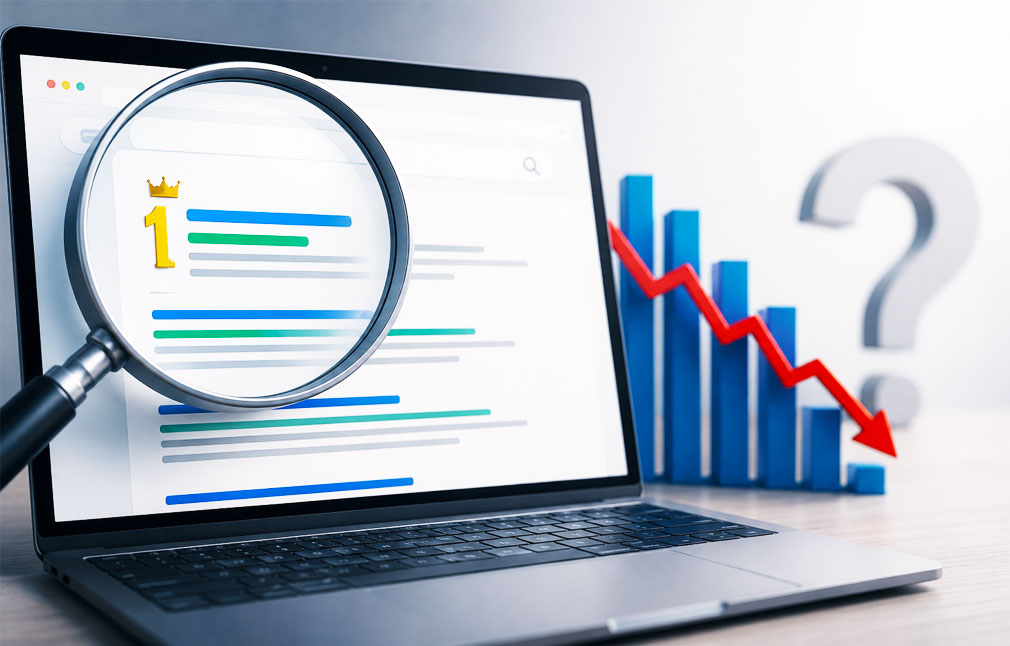
You finally did it. After months of link building, content optimization, and technical fixes, your page hit the coveted #1 spot on Google. You expected a flood of clicks. Instead, your traffic barely moved.
If this sounds familiar, you’re not alone and you’re not doing anything wrong. The rules of search have quietly changed. Ranking 1 used to be the finish line. Today, it’s just the starting point.
In this post, we’ll break down exactly why top rankings no longer guarantee SEO traffic, what’s driving the shift, and the practical steps marketing agencies can take right now to protect client performance in this new search landscape.
The Problem: Rankings Are Up, But Clicks Are Down
For over a decade, SEO ranking success was simple math: rank higher, get more clicks. That formula is breaking down, and three forces are responsible.
-
- Zero-Click Searches Are the New Normal
A growing share of Google searches now end without a single click to any website. Featured snippets, knowledge panels, and quick-answer boxes satisfy user intent directly on the results page — meaning your 1 ranking might answer the question before the searcher ever reaches your site.
-
- AI Overviews Are Eating Top-of-Page Real Estate
Google’s AI Overviews (formerly SGE) now summarize answers using large language models, often pulling from multiple sources into a single synthesized response. Your page might be cited as a source, but the click goes nowhere if the user’s question is already answered above the fold.
-
- Search Intent Has Fragmented Across Platforms
Users increasingly start their research on ChatGPT, Perplexity, TikTok, or Reddit before ever touching Google. Traditional SEO ranking data doesn’t capture this shift, which means agencies reporting only on Google position are missing the bigger traffic picture entirely.
Real-World Scenario: The SEO Traffic Trap
Consider a B2B SaaS client ranking 1 for a high-volume, informational keyword. Their SEO traffic report looks great: strong position, healthy impressions. But conversions are flat. Why? The AI Overview above their listing already answers the query, and the few users who do scroll down are comparison-shopping, not ready to buy.
This is the SEO traffic trap: vanity metrics (rankings) improving while business metrics (leads, revenue) stay flat. Agencies that only report rank position risk losing client trust when this gap becomes visible.
What to Do About It: A GEO-First Framework
Ranking 1 still matters, but it’s no longer sufficient on its own. Here’s how forward-thinking agencies are adapting.
Optimize for Answer Engines, Not Just Search Engines
Structure content so it’s easily extractable by AI systems. Use clear, direct answers near the top of the page, followed by supporting depth. This improves your odds of being cited in AI Overviews, voice search results, and chat-based assistants — a discipline often called Answer Engine Optimization (AEO).
Prioritize Structured Data and Semantic Clarity
Schema markup helps both traditional crawlers and generative AI models understand context faster. FAQ schema, HowTo schema, and clear heading hierarchies all increase your visibility across AI-driven surfaces, not just the traditional blue links.
Diversify Beyond Google Rank Tracking
Track brand mentions across AI platforms, referral traffic from AI tools, and engagement metrics — not just SEO ranking position. A holistic dashboard tells a more accurate story of visibility and impact.
Build Topical Authority, Not Just Keyword Wins
Generative engines favor sources that demonstrate consistent expertise across a subject, not single high-ranking pages. Publishing interconnected, well-linked content clusters signals authority to both Google and AI models alike.
Expert insight: Agencies that shift client reporting from “rank position” to “visibility across search and AI surfaces” tend to retain clients longer — because the conversation moves from vanity metrics to real business outcomes.
Internal linking suggestion: link this section to a companion post on “SEO vs GEO vs AEO: What’s the Difference and Do You Need All Three?” for readers wanting a deeper breakdown.
Key Points
-
- Getting the first ranking does not mean getting clicks if people search and see answers via AI Overviews, zero-click searches, and are very selective on a search engine results page.
-
- SEO ranking and SEO traffic are two related but different indicators that it is better to keep under the radar at the same time.
-
- Preparing the content for getting extracted (AEO) can help your searchability on AI-driven search platforms.
- Track multiple ways for online visibility, not just through the rank in Google.
Ready to Future-Proof Your Search Strategy?
Rankings alone won’t sustain growth in an AI-driven search era. At MLS Digital Solutions, we help agencies and businesses build strategies rooted in SEO, AIO, and GEO, so visibility translates into real traffic and real results.
Contact MLS Digital Solutions today to audit your search strategy for the AI search era.
Frequently Asked Questions

Abhishek Sharma is a digital marketing expert and the Founder & CEO of MLS Digital Solutions. With over 22 years of experience, he specializes in search engine optimization, paid advertising, website growth, and AI-driven content strategies. He regularly writes about SEO, Google updates, local search, and lead generation, helping businesses adapt to the evolving digital landscape. His mission is to turn data into growth and build marketing strategies that deliver real business results.